
Transitional

Navigate: Understanding Children’s Digital World
Wednesday 8th July | 1pm - 2pm | FREE Online Webinar
*Please register even if you can't make it as we will be sending out a recording!
The online world is changing faster than most parents can keep up.
One minute your child is watching videos on YouTube. The next they're talking about Snapchat streaks, TikTok trends, Discord servers, AI apps or online influencers you've never even heard of.
It can feel overwhelming.
You want to protect them, but you also don't want to become the parent who's constantly saying "no", checking devices or arguing about screen time.
Perhaps you've found yourself wondering...
What is my child actually doing online?
Who are they talking to?
How much screen time is too much?
Why do they seem so attached to their phone?
Are influencers changing the way they think about themselves?
How do I keep them safe without damaging our relationship?
If you've ever asked yourself any of these questions, you're certainly not alone.
The digital world isn't something all generations grew up with, yet today's children are navigating it every single day.
The good news? You don't need to know every app or every trend to become your child's greatest source of support.
Introducing Navigate
Navigate is led by George, whose unique experience allows him to see the online world from both a young person's and a parent's perspective.
Working closely with children and young people within a school setting, George understands the platforms, trends, language and online culture that shape their daily lives. At the same time, through his experience supporting families and his background in social work, he also understands the very real questions and concerns that parents and carers face.
The session will also be supported by Claire, the founder of Inspire You, an experienced therapist, coach, and wellbeing consultant.
This combination means the workshop isn't about creating fear or dismissing technology - it's about translating the digital world into something parents can better understand, giving you the confidence to support your child without feeling like you're constantly playing catch-up.
Unlike watching a YouTube video or scrolling through online advice, this is an opportunity to learn in a supportive environment where you can ask questions, explore real-life situations and hear the concerns of other parents who are navigating many of the same challenges.
This workshop is also the first step in a wider parenting pathway. If you find the session helpful, there will be opportunities to continue learning through future workshops that explore some of today's biggest parenting challenges in greater depth, helping you build confidence and practical skills as your child grows.
Why this workshop matters
Technology isn't going away.
Social media isn't disappearing.
Gaming is part of many children's social lives.
Rather than trying to remove these experiences altogether, the most powerful thing parents can do is understand them.
When children feel listened to rather than judged, they're far more likely to speak openly when something doesn't feel right online.
Navigate helps you build that understanding.
During the workshop we'll explore...
- Why young people are drawn to online spaces: independence, belonging and friendships
- Popular platforms including TikTok, YouTube, Instagram, Snapchat and gaming communities
- Positives and negatives of digital platforms
- Algorithms, advertising and online influence
- Emerging concerns, including online culture and influencer impact
- Developing critical thinking skills
- Healthy online habits and safety settings
By the end of the workshop you'll...
✔ Feel more confident talking to your child about their online world.
✔ Better understand the apps, games and platforms they use.
✔ Know how online algorithms and influencers shape what children see.
✔ Have practical ideas to encourage healthier screen habits.
✔ Understand how to guide rather than control.
✔ Leave feeling more informed, reassured and confident as a parent.
Meet George & Claire

Navigate is delivered by George and Claire, bringing together two complementary perspectives to help parents better understand the ever-changing digital world.
George works directly with children and young people in a school setting, giving him first-hand insight into the challenges they face every day. He sees how social media, gaming and online culture can influence children's confidence, emotions, friendships, behaviour and wellbeing - not only online, but in the classroom, at home and within family relationships.
Alongside his work in schools, George supports young people through one-to-one emotional wellbeing sessions, helping them build resilience, confidence and healthier ways of managing the pressures they experience. As a Social Work student, he is also developing a strong theoretical understanding of child development, safeguarding, family systems and the wider factors that influence young people's lives. His combination of lived experience alongside children and professional training allows him to translate today's digital culture into practical, relatable guidance for parents.

Claire brings over 17 years' experience supporting children, young people and families. Executive Coach, therapist and founder of Inspire You Wellbeing, she has worked across schools, children's services, CAMHS and private practice, supporting families through a wide range of emotional, behavioural and wellbeing challenges. Throughout her career she has seen how rapidly the online world has evolved, bringing both incredible opportunities and new challenges for children and those caring for them.

Why We Built CoreSeven: Our Journey from Boutique Consultancy to Systemic Mental Fitness
Why We Built CoreSeven: Our Journey from Boutique Consultancy to Systemic Mental Fitness
For a long time, the world of workplace wellbeing has felt a bit like a game of catch-up. We wait for the burnout to happen, then we offer a subscription to a meditation app. We wait for the team conflict to reach a breaking point, then we call in a mediator. We wait for the crisis, and then we react.
At Inspire You Wellbeing, we’ve spent years working as a boutique consultancy, sitting at the intersection of HR, coaching, and therapy. We’ve seen firsthand how pressure at work and the complexities of real life: parenting, neurodiversity, trauma, and health: don’t stay neatly outside the office door.
But as we grew, we realised that while deep, bespoke consultancy is powerful, the scale of the challenge required something more systemic. We needed a way to help organisations move from a culture of "crisis management" to one of "proactive mental fitness." We need something affordable, accessible and easy to guide people without being preachy or commanding hours of therapy.
That is why we built CoreSeven.
From Boutique to Systemic: The Evolution
When we started, our mission was simple: help people assess where the problem is, feel better so they can work better. We worked with self development enthusiasts, wellbeing partners, leadership teams, parents, and schools, providing high-touch, human-centred support. However, we noticed a recurring pattern. Even the most well-meaning organisations were often treating wellbeing as a "perk" or a "reactive safety net" rather than a core business strategy. Individuals had good intentions but were not accountable to commit to changes and didn't know where to start or what the journey looked like.
We wanted to bridge the gap between business performance and emotional wellbeing. We knew that ways to create meaningful change required a shift in how we view the human nervous system in the workplace.
CoreSeven is the culmination of that journey: a systemic mental fitness platform designed to build resilience before it’s needed. What began five years ago as an assessment tool gradually evolved into something much bigger. First came a static membership platform. Then a more gamified version. Last year, we built it into the back of our website as the thinking continued to sharpen.
Over time, it became clear that CoreSeven was asking for its own space. It is no longer a feature sitting quietly inside Inspire You. It has grown into a standalone platform with its own domain, its own website, and a clearer, more professional identity.
As CoreSeven evolved, we realised it had grown beyond being simply a service within Inspire You. It had become its own ecosystem, methodology and long-term vision for how mental fitness could be approached differently.
Creating a separate platform and domain allowed us to build something bigger than traditional wellbeing support alone: a scalable, accessible system that could support both individuals and organisations in a more proactive and sustainable way.
Prevention over Crisis: The New Priority
The current "crisis-first" model is exhausted. HR teams are overwhelmed, managers are burnt out, and employees often feel that wellbeing support only arrives when they are already at their limit. Health and support systems are increasingly overwhelmed, with many people struggling to access support until they are already in crisis. During our time working in the NHS, we heard a version of the same sentence again and again: "I wish I had help sooner."
Our "Prevention over Crisis" mission is about moving upstream. It’s about recognising that by the time someone needs a crisis line, a lot of opportunities for support have already been missed. By focusing on mental fitness, we can build the internal resources: the "muscles": that allow people to navigate stress, uncertainty, and high-pressure environments without reaching a breaking point.
What Do We Mean by Mental Fitness?
We often talk about physical fitness as something we "do" to stay healthy, not just something we think about when we get sick. Mental fitness is exactly the same.
It isn't just the absence of mental illness; it is the proactive building of the inner and outer capacities that help us navigate life well. In our mental health awareness reflections, we often discuss how true wellbeing isn't a destination, but a practice.
At the heart of CoreSeven are 7 interconnected Rhythms of life and wellbeing. Because mental fitness is not built through one single habit, app, or intervention. It is shaped through the interaction between how we think, move, recover, connect, work, grow, and navigate change. The 7 Rhythms of Life are:
- Physical: Sleep, Movement, Nutrition
- Emotional: Awareness, Regulation, Resilience
- Growth: Mindset, Identity, Learning
- Social: Connection, Belonging, Communication
- Financial: Spending, Earning, Security
- Occupational: Satisfaction, Progress, Balance
- Transitional: Change, Loss, Adaptation
Each rhythm, or Beat, also has four levels: Awareness, Consistency, Performance, and Mastery. This is an important part of the platform’s systemic design. It means CoreSeven is not simply offering isolated wellbeing ideas or one-off interventions. It helps people and organisations understand where they are now, build steady foundations over time, strengthen performance in a sustainable way, and develop deeper long-term capability across every area of life.

Human-Centred Leadership in Practice
Building a platform didn't mean we wanted to lose our "human-centred" touch. If anything, it allowed us to embed it more deeply. Human-centred leadership isn't about being "soft"; it’s about being smart. It’s about acknowledging that a leader who understands their own nervous system is a leader who can hold space for a high-performing, psychologically safe team.
We believe that sustainable performance is only possible when we stop treating work life and real life as separate entities. When an employee is struggling with family pressures or neurodivergent burnout, they don't leave that at the door. CoreSeven helps organisations build a culture where these realities are seen and supported, creating a more resilient and loyal workforce.
A Holistic Ecosystem of Support
We’ve always known that wellbeing doesn't happen in a vacuum. It happens in our kitchens, our communities, and our local high streets. That’s why our approach to mental fitness includes a wider ecosystem of support. We call this "Glocal."
For us, Glocal means thinking globally about what people need, while building support locally and relationally. We are proud to be based in Sussex and to partner with local businesses and practitioners who share our values around holistic health and human-centred support. Further afield, we draw on a wider network of aligned partners so people can access the right support close to where they are. It means we can stay rooted in community whilst offering something responsive, personal and joined-up.

The Path Forward

The transition from a boutique consultancy to a systemic platform has been a journey of listening. We listened to exhausted HR directors, overwhelmed parents, people trying to hold everything together quietly, and organisations wanting to do better but not always knowing where to start.
We believe the most powerful changes often start with the person sitting right in front of us. That is the heart of the Ripple Effect. When one person builds awareness, resilience and healthier rhythms, that change rarely stays contained to them alone. It often ripples outward into families, teams, workplaces and communities. In that sense, supporting personal growth is not separate from wider organisational change. It is often how meaningful, lasting change begins.
CoreSeven is our answer. It is a commitment to individual self development and wider organisational workplace wellbeing strategies that actually work because they are rooted in how humans actually function. There is a clear journey.
It’s time to stop waiting for the crisis. It’s time to start building the fitness.
Ready to move from crisis management to mental fitness?
We are currently inviting a select group of purpose-driven leaders and individuals to join our Founding Members list. As a founding member, you’ll be the first to access the platform and receive exclusive benefits as we build the future of systemic wellbeing together.
Join the Founding Members List here

Good Enough Parenting: 3 Ways to Support your Child’s Emotional Wellbeing Without Being Perfect
Good Enough Parenting: 3 Ways to Support your Child’s Emotional Wellbeing Without Being Perfect
Children’s Mental Health Week can stir up a lot for parents. It can bring pride, love, and deep care, but also quiet questions that creep in during the busy, messy moments of everyday life:
- Am I doing enough?
- Have I been patient enough?
- Did I handle that well?
If you’ve felt more emotional or reflective than usual about your child lately, you’re not alone.
CHILDRENS THERAPY
Our children’s therapy services support children around the Shoreham-by-sea area who struggle with emotional regulation, big feelings, shutdowns, anxiety, or behaviour that feels hard to understand.
What is “good enough” parenting?
The paediatrician and psychoanalyst Donald Winnicott introduced the idea of the “good enough” parent. Not the perfect parent. Not the endlessly patient, never snappy, always available parent. But a parent who is human and emotionally present enough for their child to feel safe and secure.
Winnicott believed that children don’t benefit from perfection. In fact, small, manageable frustrations, not always getting what they want, and learning that others have needs too, help children build resilience, independence, and emotional strength.
Being “good enough” means:
- Showing up most of the time
- Repairing things when they go wrong
- Letting children experience life’s bumps while knowing they are loved
But real life is more complicated than theory.

When life feels like too much
What happens when the frustrations children face aren’t just small, manageable ones?
What about when parents are exhausted, stretched, or overwhelmed themselves?
Children don’t just need limits and learning experiences; they also need unconditional positive regard. They need to feel that even when their behaviour is loud, withdrawn, or challenging, the relationship underneath is safe.
That’s hard to offer consistently when you’ve:
- Had a draining day at work
- Snapped at someone you didn’t mean to
- Been running on too little sleep
- Walked home in the rain
There is no guidebook for parenting in those moments. No script for how to stay calm when you feel anything but. And yet, those are often the exact moments children need us to help them make sense of their big feelings.

1. Model imperfection and repair
One of the most powerful things a parent can say is:
“I got that wrong, I’m sorry.”
When you lose patience or misread a situation, repairing the moment teaches children that relationships can bend without breaking. It shows them that mistakes don’t mean disconnection. That’s a core part of “good enough” parenting.

“Being there” changes as children grow
When children are small, being present can feel more straightforward. You’re physically there to comfort, distract, and soothe. As they get older, things shift.
They spend more time alone. Their social world gets bigger. Pressures increase, including friendships, school expectations, and the online world. They are left to regulate themselves without you right beside them.
That can be scary for parents. You can’t step in every time to protect them from every disappointment or conflict. While it’s natural to want to remove every obstacle from your child’s path, constantly managing all their stress can make it harder for them to develop the confidence and emotional tools they’ll need later on.
Children don’t just need problems solved for them. They need support to understand their feelings.

2. Name feelings (even when you can’t fix them)
When children are overwhelmed, they don’t always need solutions straight away. They need help making sense of what’s happening inside.
You might say:
- “It sounds like today felt really lonely.”
- “I can see how frustrated you are.”
- “That must have felt embarrassing.”
Naming emotions helps children learn that feelings are manageable, not something to hide or fear.

You’re carrying a lot, your child might be too…
Many parents right now are juggling more than ever. The constant sense of needing to be in two places at once is undoubtedly creating a lot of stress and pressure at home.
Even when you try to shield your child from it, they often pick up on the emotional atmosphere. Some children become louder and more demanding. Others go quiet and try to be “easy.” Both can be signs they’re carrying feelings they don’t yet have the words for.
Feeling like you’re not doing enough doesn’t mean you’re failing. Often, it means you care deeply and are trying to hold everything together.
But you don’t have to do that alone.
3. Let them be challenged with you nearby
It’s natural to want to remove stress from your child’s life. But manageable challenges are how children build resilience.
Instead of stepping in immediately, try:
- Encouraging them to think of one thing they could try
- Reminding them of a time they coped before
- Letting them know you’re there if they need help
This builds confidence while keeping the safety net of your support.

Many parents right now are juggling more than ever. The constant sense of needing to be in two places at once is undoubtedly creating a lot of stress and pressure at home.
Even when you try to shield your child from it, they often pick up on the emotional atmosphere. Some children become louder and more demanding. Others go quiet and try to be “easy.” Both can be signs they’re carrying feelings they don’t yet have the words for.
Feeling like you’re not doing enough doesn’t mean you’re failing. Often, it means you care deeply and are trying to hold everything together.
But you don’t have to do that alone.
CHILDRENS THERAPY
Our children’s therapy services support children around the Shoreham-by-sea area who struggle with emotional regulation, big feelings, shutdowns, anxiety, or behaviour that feels hard to understand.

What Kind of New Year’s Resolutioner Are You? (And How to Avoid Burning Out Before February)
What Kind of New Year’s Resolutioner Are You? (And How to Avoid Burning Out Before February)

FREE 7-DAY RESET CHALLENGE
The 7-Day Reset Challenge is a gentle way to reset your energy and focus. One short video a day, accessed in your browser, with no rules, no rigid targets, and no guilt if you miss a day. You can simply return - without shame.

Every January, we’re told this is the year. The year we finally get disciplined, motivated, productive, healthier, calmer, richer, happier… all at once. And yet, by February, many people feel exhausted, disappointed, or quietly giving up - wondering what went wrong again.
The truth? It’s not that you lack willpower. It’s that not all New Year’s resolution styles are created equal, and some are far more likely to lead to burnout than others.
Why Most New Year’s Resolutions Fail (and Lead to Burnout)
Before we dive into the personas, it helps to understand why New Year’s resolutions so often backfire.
Common causes of January burnout include:
- Setting too many goals at once
- Relying on motivation instead of sustainable systems
- Ignoring energy, capacity, and real life
- Treating rest as a reward instead of a requirement
- Expecting instant transformation rather than progress
Burnout isn’t laziness. It’s your nervous system saying 'this pace isn’t sustainable'. Now, let’s find out which resolution style you fall into - and how to work with it, not against it.

The 5 Types of New Year’s Resolutioners
As you read, notice which one makes you think: “Oh… that’s me.”
(If more than one fits - that’s completely normal.)
The All-In Overachiever
“This year I’m changing EVERYTHING.”
How to spot yourself:
- You set big, ambitious goals across health, career, finances, routines, mindset
- You love structure, plans, trackers, and colour-coded systems
- January feels exciting… until it suddenly feels overwhelming
- By February, you’re exhausted or quietly frustrated with yourself
Strengths: Driven, capable, visionary
Burnout risk: High - due to intensity and pressure
How to avoid burnout this year:
- Choose one core focus (not five)
- Aim for consistency over intensity
- Build in planned imperfection - missed days don’t equal failure
- Ask: What would “good enough” look like?
Try reframing resolutions as habits that support energy, not goals that demand output.

The Motivated-But-Exhausted Juggler
“I really want this… I just don’t have the time or energy.”
How to spot yourself:
- You genuinely want change, but life is already full
- You’re balancing work, family, responsibilities, emotional load
- You start January hopeful but tired
- Your goals quietly slip down the priority list
Strengths: Responsible, caring, realistic
Burnout risk: Emotional and physical depletion
How to avoid burnout this year:
- Stop asking “What should I add?” - Start asking “What can I simplify?”
- Set micro-goals that fit into real life (5–10 minutes counts)
- Tie habits to things you already do
- Focus on maintenance, not transformation
Sustainable change for you starts with reducing load, not increasing effort.

The Perfectionist Starter
“If I can’t do it properly, I won’t do it at all.”
How to spot yourself:
- You spend time researching the best approach
- You wait for the “right” time, energy, or plan
- A small slip feels like total failure
- You restart… often
Strengths: Thoughtful, high standards, reflective
Burnout risk: Mental fatigue and self-criticism
How to avoid burnout this year:
- Lower the entry bar - messy action beats perfect plans
- Decide your minimum viable habit
- Track progress in weeks, not days
- Practice self-compassion as a skill, not an afterthought
Progress doesn’t come from doing it perfectly - it comes from staying in the game.


Therapeutic Coaching (10% Off Consultations)
Tired of Pushing Yourself Just to Burn Out Again? Therapeutic coaching helps you slow things down and understand the patterns behind your habits, stress, and self-pressure. It’s about creating change that actually lasts. Find out more.
The “New Year, New Me” Optimist
“This time it’ll be different!”
How to spot yourself:
- You love the fresh-start feeling of January
- You’re enthusiastic, hopeful, and future-focused
- Motivation dips sharply once novelty fades
- You feel disappointed when the buzz wears off
Strengths: Positive, imaginative, open to growth
Burnout risk: Motivation crashes and self-doubt
How to avoid burnout this year:
- Expect motivation to drop - and plan for it
- Replace motivation with simple routines
- Anchor habits to identity: “I’m someone who…”
- Celebrate effort, not outcomes
Change sticks when it becomes part of who you are, not just something you’re excited about.

FREE 7-DAY RESET CHALLENGE
The 7-Day Reset Challenge is a gentle way to reset your energy and focus. One short video a day, accessed in your browser, with no rules, no rigid targets, and no guilt if you miss a day. You can simply return - without shame.
The Quiet Non-Resolutioner
“I don’t really do New Year’s resolutions.”
How to spot yourself:
- You’ve been burned before
- January feels pressured or performative
- You prefer reflection over big declarations
- You still want change - just not the hype
Strengths: Self-aware, grounded, independent thinker
Burnout risk: Low - but stagnation can creep in
How to avoid burnout (and still grow):
- Set intentions, not resolutions
- Choose a word or theme for the year
- Focus on how you want to feel, not what you want to achieve
- Review monthly, not annually
Growth doesn’t have to be loud to be meaningful.

A Final Thought
If this has made you realise that your expectations of yourself tend to be sky-high at the start of the year, you’re not alone.
January often comes with an unspoken pressure to fix everything at once. To be more productive, healthier, calmer, more focused - immediately. And for many people, that pressure is exactly what leads to burnout before February even arrives.
You don’t need to set yourself such high expectations this year. You don’t need another intense plan or an all-or-nothing resolution. Sometimes, what actually helps is a reset - something gentle, realistic, and achievable.
That’s why we created the 7-Day Reset Challenge.
It’s designed to help you ease into the year rather than sprint into it. The challenge runs entirely in your browser, so there’s nothing to download or set up. Each day, you’ll receive one short video, guiding you through a simple reset you can actually fit into real life. No overwhelm, no long to-do lists - just one intentional step at a time.
Over the 7 days, the challenge helps you:
- Reset your energy and headspace
- Reduce mental overload
- Rebuild momentum without pressure
As you move through the challenge, you’ll also earn points for taking part. If you decide to continue your journey afterwards, those points can be used within our wider CoreSeven membership, so the effort you’ve already made carries forward rather than being wasted.
And if life gets in the way? That’s okay.
There’s no failing, no catching up, and no guilt attached. You can pause, return, and continue whenever you’re ready - without shame.
Because sustainable wellbeing isn’t about doing more or trying harder. It’s about creating rhythms that support you, even when things don’t go perfectly.
If you’d like a calmer, more supportive way to begin the year - something you can realistically stick to - the 7-Day Reset Challenge is a great place to start.
FREE 7-DAY RESET CHALLENGE
The 7-Day Reset Challenge is a gentle way to reset your energy and focus. One short video a day, accessed in your browser, with no rules, no rigid targets, and no guilt if you miss a day. You can simply return - without shame.
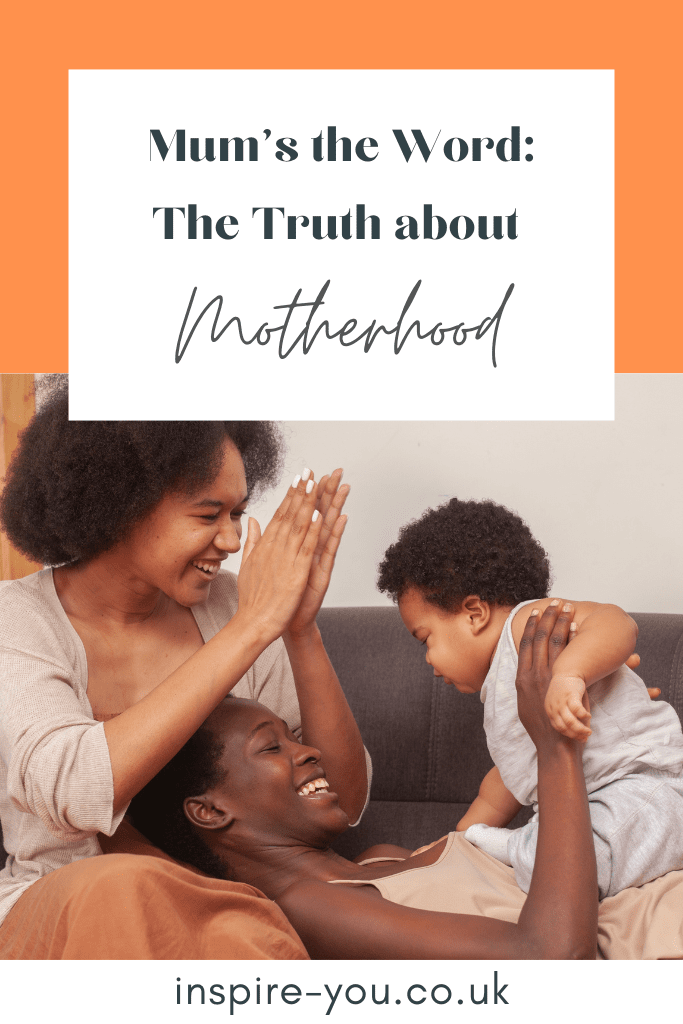
Mum’s the Word: The Truth about Motherhood
The Truth about Motherhood:
By Rhiannon Williams
It’s International Women’s Day, a time used to celebrate the past and current achievements of women from all over the world. This year we wanted to talk to the people who are raising our future. Mums!
When my son was first born, everything changed for me. My friend group looked different, my clothes didn’t fit, my hair always smelt ever so slightly of milky sick, and my body wasn’t my own anymore.
I quickly felt myself become this machine-like object that needed to run the house, keep a tiny human alive, love their partner as much as they did before and look happy while doing it.
In the process of making sure everyone else was okay, I fell behind myself. I remember looking in the mirror at about 3am on the way to grab another muslin from the pile clean washing and not even recognising the woman that stood in front of it.
It wasn’t just the way I looked, but the blank expression behind my eyes. The overwhelming sense of tired that absorbed my days and ate away at me through the night.
I forgot who I was, and I struggled to know how to reconnect with the things that had once made me happy. There never seemed to be time!
Of course, my son made me happy, and I love him more than anything in the world. That’s why I felt so much guilt about the fact that he wasn’t enough for me, I needed something else.
There’s a pressure in society that expects mothers to be the perfect parenting robot. There are countless classes and articles that teach us how to birth, bathe, discipline, breast-feed, bottle-feed, sterilize, nappy change, sleep train (the list goes on…and on…and on)
The internet isn’t short of opinions on exactly how to look after a child, in fact you will probably hear the unsolicited advice from family, friends and the old lady waiting in line at your local supermarket.
The thing that no one seems to have a 3-day-snacks-included-worksheets-provided class on is how to stay connected to “yourself” even though you will never be “yourself” again.
For me, it was a journey that started with a fizzy bath bomb and a cup of tea. I spent a little extra time in the bath on a Friday evening while my partner took over so I could have my own personal space back, even if it were just for an hour.
This moved on to finding a good babysitter who could take over once a month so my partner and I could reconnect with the stranger that we had both become after many busy days and sleepless nights.
I’m almost 18 months on from that mirror moment now and I can honestly say my heart has never felt so full. I recognise myself but I’m stronger than before, more kind and willing to love. I am selfless and sometimes selfish because it’s okay to have both.
Yes, my eyes still look tired, and my tummy is wobblier than before, but I have figured out the balancing act that is being a mother, and it is the greatest circus trick there is to learn.
I wouldn’t change being a mum for the world, but I wish I knew there was more to motherhood than looking after a baby. If I could turn back time, I would remind myself to take more time for me.
Everyone who came to help out wanted to hold the baby, but I think as mothers we need to feel held too.
I felt really isolated in this experience until I started talking to other mums, and I realised that most mothers felt they had lost a piece of themselves in the chaos of motherhood.
I decided that the truth about motherhood needed to be heard. The good and bad!
That’s why we’ve asked 4 mums to share their experience in motherhood and what it means to them.
Meet Our Mums
If you could describe yourself in 3 words, what would they be?
Heidi, 30, North Wales:
Organised, Outgoing, Overwhelmed
Jade, 21, Brighton:
Bubbly, Compassionate and Optimistic
Lily, 31, Hertfordshire:
Thoughtful, Intuitive, and Strong.
Viola, 37, Sussex:
Slow, Thorough, Thinker
What does motherhood mean to you?
H: Raising happy, supported, loved little people who will go out into the world and make it a more kind and accepting place. I aspire for my kids to be mentally sound and know that they have stability from their parents, everything else comes second to that.
J: Being a mum is the best thing that has happened to me, my son gave me a purpose, a path in life that I’m excited and proud to be on. Motherhood is so much more than just “being a mum”. It’s a journey in your life that is excitement, lessons to learn and new experiences.
L: Motherhood means love, so much love but also chaos.
V: It makes me feel part of something, like being part of a gang. I felt that belonging through all the prenatal groups and baby groups and with school parents. I wish there was more of a fatherhood. I don’t see much of that for Dads.
Since having children, do you feel like you have struggled with your identity?
H: After my first I struggled to feel anything other than ‘frumpy mum’ despite the fact I was only 23 and put time into hair, make up and clothes. I put that down to not feeling ready, it took a long time to adjust. After I had my second at 28 and third at 30 it took no time to feel myself again, especially now I exercise to fit back into my old clothes, buying a whole new wardrobe would probably make me feel a bit lost.
J:At first the main thing I struggled with, and unfortunately am still struggling with is my appearance. I don’t quite know myself anymore when looking in the mirror.
The stretch marks, loose skin, the weight gained naturally during pregnancy and any other differences since before pregnancy really made an impact on knowing who I was, and I couldn’t understand why I felt so detached from myself. However, each day gets easier, and I know that I am still me, but now with a beautiful baby boy that my body gifted me with.
L: I struggled a lot more in the first year of her life but now I’m settling more into the role of being a mother. I had no idea who I was for a while, and I missed my old life terribly. I felt as if I had lost my carefree, adventurous, and spontaneous self. I felt dull and lifeless.
V: No, I don’t feel I need an identity. I don’t really think about my identity or what that is. I don’t think I did before kids either.
Does having children stop you from doing what you would like to do?
H: Not much socially, I have a very supportive partner who insists I make plans with friends, although getting time for us to spend time together is harder. It has definitely put a halt on my career though.
J: I thought having a child young would make me feel like I was missing out on my “prime years” however I feel like I’ve had more opportunities since having him. Things that mean so much more to me than having a hangover; actual memories with the people I love around me!
L: I would love to go back to study whilst also being able to work full time but it’s just not doable with a toddler. I would love to travel or just be able to hop on a plane spontaneously and see friends in other countries like I used too.
V: It stops me from working, but that may be a good thing! I don’t do so much of my hobbies now or go on long walks. But I’m not sad that it stops me from doing those things because they’ve been replaced by so many more lovely things.
Has having kids changed your life in a way you didn’t expect it to?
H: Before I had kids, I had no goals or aspirations, I didn’t finish high school or do uni or college and actively avoided putting myself forward for promotions at work because I didn’t want the responsibility. Now I have goals to work towards, I don’t sleep all day or get totally consumed by small negative things because I have other little people to focus on.
J: I think having kids changed my life in such a positive way, I sort of expected to feel lost in myself and not know what to do once having a child as it’s such a life changing thing. However, I feel like having him just set me on the path I was supposed to be on, it feels extremely natural, and I couldn’t imagine not being a mummy.
L: I feel like it’s the making of me in a lot of ways. As hard as it is (and it’s very hard) I didn’t realise how good I would be at it and how much I would enjoy it and how much love I had to give, as corny as that sounds.
V: I think I mostly expected it. I expected the unexpected perhaps. And I still don’t know where it’ll go from here. Let’s wait and see.
What does “feeling like me again” mean to you?
H: When I can go out with my friends without my kids, I can eat a hot meal, hold a real conversation without being interrupted, I can talk about relationships, work, and family.
J: I think I’d define “feeling like me again” as fitting back into my favourite outfits, looking at myself and feeling beautiful and confident like I once did. I’m not in a rush though and I’m content with the way I am now.
L: I don’t think I’ll ever feel like the old me again because there are parts of her that don’t exist anymore. Most of those parts had served their purpose anyway and I’m happy to see them go. Feeling like me again now feels more like just being able to have more time for myself and being able to do things I enjoy without mum guilt, anxiety, or intrusive thoughts.
V: I guess having the freedom to do the things you like. I like having kids and I chose to have them. I feel like, having kids and all that comes with it, is me.
Do you separate being a mother and being yourself, or is it one person?
H: Funnily enough when I’m with my mum friends it’s all the same person. When I’m with my non-mum friends (none of my long-term friends have kids) I can feel like my old self again and chat about things other than school stuff, sleepless nights and worrying about odd rashes on the kids.
J: I am still my own person, I don’t think being labelled a mum is necessarily taking away from my own identity as I am a mum, and being a mum is amazing! I don’t need the separation between the two as being them together is perfect for me.
L: I’m unsure actually…I feel both ways. Some days it feels like one person and other times I separate the two in my head. Maybe in times I feel more carefree and want access to ‘just’ me.
V: It’s one person to me.
Do you think mothers are given enough support to be who they want to be?
H: No, the childcare situation is a nightmare, if you don’t have time away from your kids to breath, self-care and unwind how are you supposed to fully feel how you want to?
If you can’t do the job or course you want to, you don’t have hobbies and only have enough time in the mornings to run a brush through your hair how are you ever supposed to feel you’re who you want to be?
Being able to access affordable childcare could mean a mum can work on HER career or look after HER mental health. I also don’t think childcare should be just for work, I think it should be encouraged to use for having “you” time without there being shame attached it.
J: I think there’s a lot of stigmas around being a young mum which adds pressure for us. It feels frowned upon to get a babysitter and go out when you’re a young parent, but I think if somebody older did it, the night becomes a “well deserved break” but for us it’s seen as irresponsible and selfish.
L: I feel like mothers have a lot of expectation from society. Expectation to be everything to their children but also to uphold a career, manage a household, and take on the mental load of all this all whilst not having access to affordable childcare. So no, I don’t.
V: It depends on what you need. If you need time to yourself, then hopefully you can find that somehow with support from others. It depends on everyone’s own situation.
What support do you wish existed or that you could have gotten?
H: Affordable childcare!
J: I don’t think mums are given much support or advice when being discharged from the hospital. I wasn’t told anything and was just expected to know everything, you’re handed your baby, discharged, and expected to know exactly what you’re doing because it’s “in our nature” as mums.
L: Affordable childcare definitely! And I feel like all mothers deserve access to therapy too. I wish I would’ve had more support through having Post-Partum Depression.
V: Free childcare options, longer and better paid maternity and paternity leave, more annual leave for both parents to at least cover school holidays. It would be nice to have family living closer to each other.
What do you wish people knew or respected about motherhood?
H: Parenting is different now to how it was 20 years ago, mums are particularly more isolated than before, there is less support with both childcare and just generally for mums to have the comfort of a chat and cup of tea with a family member.
J: Unsolicited advice! We do not want it, nor do we need it. It feels so judgemental when people you don’t spend time with and who don’t know you well are giving you advice on how to parent your child.
L: How much it will change your life. I always tell friends who want children to just do everything they possibly want to do before having them as you have no idea when you will get time to be completely selfish again. I wish more people knew about Post-Partum Depression and how bad that can get.
V: I recently quit my day job to spend more time on mothering and I don’t feel that’s a well-respected use of a person’s time. But it should be. If you have the honour (and desire) to be able to spend more time with your kids, it should be viewed as a good thing.
None of the things that go with motherhood are respected, all the housework, the organising, the care, I don’t see any of it being respected. It is respected if a man does it. It is respected if a woman can have a full-time job, raise their kids, have a tidy house, keep fit and not complain about it.
If you could give your pre-mum self one bit of advice, what would it be?
H: Stay close to family, you don’t suddenly become an old age pensioner when you turn 30 so stop mourning losing your 20’s to kids. Be assertive in your relationship and say what you want rather than following your partners goals, probably don’t get so many cats. Oh also, make a brew before sitting down to feed the baby, you’ll thank yourself.
J:
I wasted a lot of my teenage years fixating on my body image, I wish pre-mum me focused more on what she enjoyed and spent more time out with friends and family making good memories.
L:
Travel! Be free. Enjoy every second of life and never miss a therapy session.
V:
Find a way to stay calm in those moments.
*Some names and pictures are changed for privacy reasons*
If you found this brought up feelings that you still need to work through, please contact us to find out more about our therapeutic options for individuals and families. If you are showing signs of Postnatal depression or feel that you are struggling, please get into contact with your GP.

My top tips for dealing with change and uncertain times – The ‘new normal’

Why have I created these tips?
It feels like we are bouncing from one crisis to another at the moment... first Brexit, then COVID, then change of PM (several times in recent years!), the death of the Queen and the start of a new era with King Charles, the great resignation, cost of living crisis, and this doesn't take into account anything extra on a personal level we are dealing with (caring responsibilities, personal loss, career, stress, burnout etc).
We are creatures of habit, we like and thrive on routine. When we experience change of any sort we feel unsettled. This can create trauma for us and is a bit like having a computer with too many tabs open, or everything saved on the desktop. Nothing makes sense and feels overwhelming and we run out of space to be able to think and concentrate- OUR MINDS ARE FULL and we activate our primitive Autonomic nervous system (fight flight freeze) response. Based on our lived experience of change (whether positive and embracing or negative and anxiety provoking) depends on how we react next. Our lived experience shapes our thoughts about the situation and then trigger feelings and emotions. The good news is, everything starts with our thoughts so we can do something about it and change our responses. This helps us to navigate change better.
Here are my top tips to help navigate through change:
1. UNFREEZE: Accept change is happening.
The first step in managing change is to accept it is happening. It is OK to be sad about the Queen dying even if we have never met her. We all have some connection with her over the past 70 years and she has remained our constant. The cost of living is going up. This will be hitting people hard and we are already seeing how this could look in months ahead.
2. CHANGE: Identify what needs changing. We can only control what we can control.
This sounds obvious but we are not able to change these facts. Whenever there is change we need to learn to look inwards and focus on our own 'locus of control' what can we do to help ourselves?
3. We can change ourselves, by changing our thoughts and therefore our behaviours
The thing is how we respond to changes starts with our thoughts about the changes and thoughts are not facts (despite how true they feel). We can learn to challenge our thoughts and rewire the brain to change our thoughts to alternative healthier thoughts, therefore instinctively we choose different behaviours and emotions from them.
A bit like the buying of toilet roll during the pandemic we can change our responses and reduce the stress we feel from the changes and the worry about the unknown.
4. Plan and implement any practical changes we can make.
This is useful when thinking about costs of living. Are there Direct Debits/ Standing Orders that you can cancel. Do you have vouchers you can use? Can you make use of interest free credit cards (not for everyone!). Change is 80% mindset so once we have practical changes out of the way we need to do the work. Practice flipping the thoughts using affirmations. If any of these feel to hard put 'I am learning to...' in front of them.
A few affirmations:
I face every challenge with strength
I am in control of my life and how it unfolds
I accept the things I cant change
The changes I am making are exciting and positive and bring new opportunities
change comes when we need it
I accept change with ease and release fear
5. REFREEZE: Integration
Embed the new changes as habits. Notice when old behaviours sneak in and flip them. The changes then become our new normal responses and we carry on until the next transition where we start the process all over again.
5. Seek Support:
At Inspire You we are helping people to navigate change in a positive way. Because the path well trodden in the brain can be hard to change, we sometimes don't even know when we are thinking the thoughts that are false! By seeking help from professionals we can start to support you in rewiring the brain. Using science backed approaches we support individuals to improve their performances, reduce their stress and manage life's challenges. We can support on an individual level using therapy and coaching or on a company level, helping organisations plan and implement changes to workplace culture. We have a great gadget at the moment which tracks individual's stress and recovery levels (a bit like a smart watch). This allows us to use science and work out what is causing us stress and more importantly when to implement strategies to make changes.
Need some further support? Book a free 15 minute discovery call
or.. check out my therapy and coaching page

Healing From Trauma With EMDR: When Is EMDR Right For Me?
I’ve offered EMDR therapy as a way to help people with healing from trauma since 2019. The primary purpose of EMDR is to help alleviate the intensity and impact of past trauma by reducing the vividness and emotion of certain traumatic memories, however it has also been used to successfully treat anxiety, phobias, addictions, sleep problems and complicated grief.
So even though EMDR therapy is closely associated with treating PTSD, it certainly isn’t limited to that one condition and can be effective in treating multiple different mental health conditions and creating profound change.

What Is EMDR Therapy?
The way EMDR therapy works is by helping the brain to re-process difficult, traumatic memories properly, to stop them from causing so much distress day-to-day and allowing you to live fully in the present.
Often times, traumatic events spawn intense flashbacks, upsetting thoughts or images, anxiety, depression or other distressing manifestations, as the brain becomes overwhelmed and is unable to fully process what is going on and the memory remains unprocessed or becomes “stuck”.
Such unprocessed memories and feelings are stored in the limbic system of your brain in a raw and emotional form, rather than in a verbal "story" mode. This limbic system maintains traumatic memories in an isolated memory network that is associated with emotions and physical sensations, and which are disconnected from the brain's cortex where we use language to store memories.
Emotions and sensations associated with the event stay present within the brain, and can be triggered by a certain similar stimuli resulting in overwhelming distress, or they can have a pervasive, all-encompassing impact on your mental health and daily functioning.
Even if the original memory has been forgotten, the painful feelings it produced remain stuck and manifest as anxiety, depression, anger and despair day-to-day, impacting your mental wellbeing and your ability to live in the present.
So... what does EMDR actually mean and how can it help you heal from trauma?
EMDR stands for Eye Movement Desensitisation and Reprocessing – ‘desensitisation’ referring to the reduction of the vividness and intense emotion associated with the memory, and ‘reprocessing’ referring to the new connections that arise during the treatment.

It involves bringing your traumatic event or memory into focus while you experience “bilateral stimulation” (left-to-right eye movements), although I also use the butterfly hug or tapping as a way to create these movements, especially in Covid times. Eye movements, similar to those during REM sleep, will be recreated simply by asking you to watch the therapist's finger moving backwards and forwards across your visual field.
With repeated sets of eye movements, the memory to change in such a way that it loses its painful intensity and simply becomes a neutral memory of an event in the past.
Reprocessing is usually experienced as something that happens spontaneously, and new connections and insights are felt to arise quite naturally from within. As a result, most people experience EMDR as being a natural and empowering therapy.
Is EMDR Right For Me?
So, what are some signs that EMDR might be right for you?
1) You feel ready, willing and able to discuss difficult emotions and past events
EMDR therapy is not meant to re-traumatise you or leave you feeling in any more distress once the treatment is over. However, due to the nature of the treatment, you do need to be aware of, and willing to experience, the strong feelings and disturbing thoughts that may arise during your sessions.
If you think that bringing your traumatic memory/event into focus will seriously trigger you and ultimately cause more harm than good, EMDR therapy will not be appropriate for you at this point in time.
It’s normal to feel a little nervous or apprehensive at the start of EMDR treatment if you don’t know what to expect, but it’s important to be self-aware about your ability to take on and manage the distress that may occur. You feel confident in your ability to manage the feelings that arise with your practitioner.
EMDR therapy takes place in a totally safe, non-judgmental space with a fully trained and qualified practitioner who will be there to support you through the entire process and is regarded as a safe, effective and often empowering form of therapy.
2) You feel as though a past event or mental health condition is stopping you from living your life fully in the present
You’ve lived with the manifestations of your trauma, whether that’s anxiety, depression, dissociation, insomnia, or addiction, for a long time and you’re ready to tackle the root of the problem – processing the physical and emotional memories properly.
You can identify a singular event or a prolonged experience in your life that you feel has majorly impacted on your mental wellbeing and ability to live in the present. You’re ready to take action by creating some healthy distance between you and the experience. You want to re-claim your life, stop living in the past and move forward.
3) You experience intense flashbacks to a painful event
You experience distressing and disruptive flashbacks to a traumatic experience that your brain was unable to process properly.
As well as struggling with managing your mental health day-to-day, the flashbacks you experience are a major source of discomfort and distress for you and you’re ready to take action towards ending them.

3) You’re committed to making changes in your life and experiencing the therapy in it’s entirety
Your recovery journey may require additional, on-going healing work outside of EMDR, whether that’s personal self care or therapeutic work with a practitioner.
Rather than expecting EMDR therapy to be a one-time fix-all, you approach the treatment as one healing tool in your belt and one aspect of your recovery. You are ready to embrace the treatment through all the potential discomfort for the longer-term effects, and you are dedicated and open to growth in other areas of your life.
If this has resonated with you and you’d like to try healing your personal trauma with EMDR, book in a free Discovery call with me here. This initial meeting will allow us to go over your story and pin point your particular needs and evaluate our suitability.
I offer an Overcoming Trauma package which involves bespoke EMDR support. I offer an initial assessment followed by a block of 8 sessions. NICE Guidelines recommend 8-12 sessions, and depending on complexity you may require further sessions going forward.
I am also trained in EMDR for children and in these cases, I use a lot of storytelling in the treatment process to keep it age appropriate. If you are the parent or guardian of a child you feel could benefit from EMDR therapy, please don’t hesitate to book in a Discovery call and we can discuss the next steps.
I would love to connect with you and see how I can best help you on your recovery journey – big transformations are totally possible and they begin with small steps each day.
Claire

Pin this post for later!
Need some further support? Book a free 15 minute discovery call
or.. check out my therapy and coaching page
No More Week | Identifying Emotional Abuse
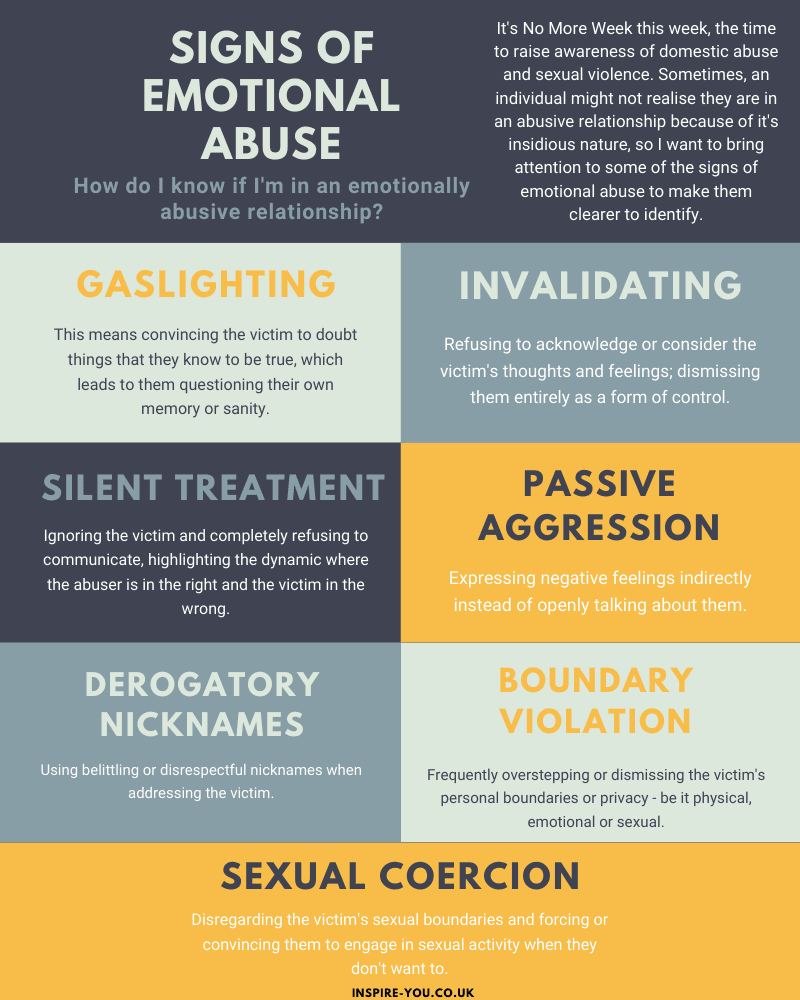
It’s No More Week this week (March 7th-13th) and this Monday also happens to be International Women’s Day! It’s the perfect time to raise awareness for domestic abuse and sexual violence.
Sometimes, individuals don’t realise that they’re in an abusive relationship due to the insidious nature of emotional abuse. It can be very gradual and incremental, seemingly normal or not a big deal at first.
But these ‘isolated incidents’ are often crucial steps in abusers’ efforts to systematically lay the groundwork for future patterns of abusive behaviour. The ultimate goal is for an abuser to subtly gain control over the victim – controlling where they can go, what they can do, who they can see or speak to, etc.
However, it’s also important to recognise that not every case of emotionally abusive behaviour is accompanied by an overarching plan to gain control, and can occur simply because there is not enough awareness about what is acceptable behaviour and what is not. If somebody has grown up in an emotionally abusive environment, they may repeat those same behaviours thinking it is normal – for example, giving the silent treatment when they are angry rather than talking openly about feelings. It may not be intentional or part of a grand plan, but it is still emotional abuse and the effects are still very real.

It can be incredibly difficult to separate the systematic abuse from the context of the relationship, which means sometimes people can rationalise or excuse what is happening to them for various reasons that make sense to them. It may take a while after a relationship ends for somebody to recognise patterns of emotional abuse that existed in the relationship. Love and dependency can cloud judgement, making it difficult to see something that you might easily spot in somebody else’s relationship.
Emotional abuse can be extremely detrimental to somebody’s self-esteem, sense of self-worth and their emotional well-being. What we can do to try and prevent emotional abuse from happening is talk openly and loudly about the lesser known signs of emotional abuse so that is becomes clearer to identify.
Here are a couple of examples of emotionally abusive behaviour:
– Gaslighting: This is when the abuser convinces the victim to doubt things that they know to be true, leading them to question their own memory or sanity.
– Invalidating: This is when an abuser refuses to acknowledge or consider the victim’s thoughts or feelings, dismissing them entirely and making them feel small or unheard.
– Silent Treatment: Where an abuser refuses to talk openly about their feelings and instead ignores the victim, creating an atmosphere that places the victim in ‘the wrong’ and the abuser in ‘the right’.
– Passive Aggression: Where an abuser indirectly communicates their negative feelings, instead of talking openly and healthily about them.
– Derogatory Nicknames: Using belittling or disrespectful nicknames when addressing the victim in a non-playful, intentionally hurtful way (although they may claim to be joking – the intention is still there).
– Boundary Violation: Frequently overstepping the victim’s personal boundaries, be it emotional, physical or sexual.
– Sexual Coercion: Disregarding the victim’s sexual boundaries and convincing them to engage in sexual activity when they don’t want to and have said no or implied they are not okay with it.
If you have experienced any kind of emotional abuse and are in need of support, you can always book in a discovery call with me here and we can discuss how we could work together to help you process what has happened and begin to move forward.
You can also visit the No More website for more information about this year’s campaign against domestic abuse and sexual violence and how you can get involved.
Take care everybody,
Claire